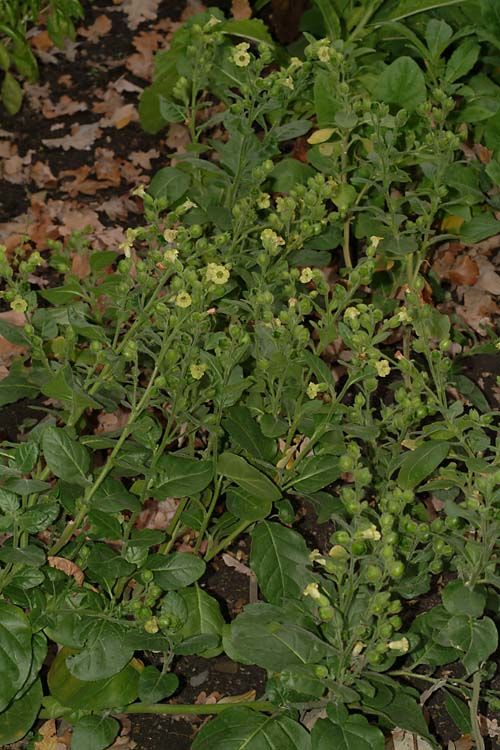
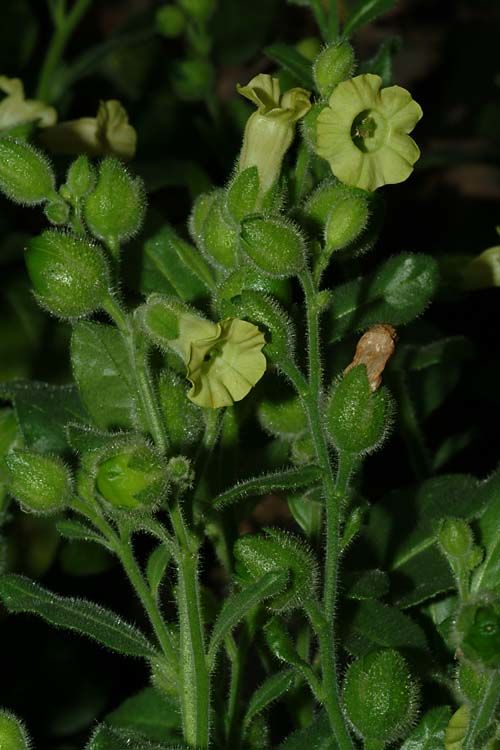
Nicotiana rustica L.

First published in Sp. Pl.: 180 (1753)
This species is accepted
The native range of this species is Peru. It is an annual and grows primarily in the subtropical biome. It is used as a poison and a medicine, has environmental uses and social uses and for food.

Descriptions

Distribution
Biogeografic region: Andean. Elevation range: 1750–4000 m a.s.l. Naturalised in Colombia. Colombian departments: Bogotá DC, Cundinamarca, Magdalena, Nariño.
Habit
Subshrub.
Ecology
Habitat according IUCN Habitats Classification: artificial - terrestrial.
Vernacular
Ambirá, Tabaco sabanero, Tabaco yuá
[UPFC]

Solanaceae, Jennifer M Edmonds. Oliganthes, Melongena & Monodolichopus, Maria S. Vorontsova & Sandra Knapp. Flora of Tropical East Africa. 2012

Type
Type: “in America, nunc in Europa, Herb. Linnaeus 245.3 (LINN!, lecto. designated by Goodspeed in The genus Nicotiana: 351 (1954) [without specimen citation]) & Deb in Journ. Econ. Tax. Bot. 1: 43 (1980). [See also Jarvis, Order out of Chaos: 693 (2007)]
Morphology General Habit
Annual herb to 1.5 m, sometimes becoming shrubby.
Morphology Stem
Stems erect, all parts conspicuously viscid-villous, with spreading simple glandular-headed hairs
Morphology Leaves
Leaves often fleshy, viscid, lanceolate, ovate-lanceolate to cordiform, 8–16.5(–26) × 4–9(–22.5) cm, upper leaves often smaller, bases cordate to cuneate, apices obtuse to acute, villous but hairs sparser on upper surfaces; petioles 2–8 cm long
Morphology Reproductive morphology Inflorescences
Inflorescences sparsely branched panicles; flowers opening by day; pedicels always erect, 4–5 mm long in flower, 5–10 mm long in fruit, densely glandular-villous
Morphology Reproductive morphology Flowers Calyx
Calyx campanulate to cupulate, 6–10 × 4–8 mm, densely glandular-pilose externally, lobes unequal, broadly triangular, 1.5–4 × 1.3–4.5 mm, acute, enlarging in fruit
Morphology Reproductive morphology Flowers Corolla
Corolla yellow, greenish-yellow to whitish, broadly cylindrical to tubular below, ampliate becoming urceolate above, 1.4–2 × 0.5–1.1 cm diameter apically; tube inflated, 1.2–2 × ± 2 mm wide basally increasing to 8 mm apically below lobes where constricted, pilose externally, glabrous internally; lobes shallow, 1.5–2 × 5–6 mm, acute or slightly apiculate, spreading after anthesis
Morphology Reproductive morphology Flowers Androecium Stamens
Stamens unequal with fifth usually longer, occasionally shorter; filaments free for 7–10 mm, with fifth free for 6–7 mm; anthers yellow, cordiform, 1.5–2 × 1.2–1.8 mm
Morphology Reproductive morphology Flowers Gynoecium Ovary
Ovary ovoid to conical, 1.7–2.5 × 1.2–2 mm; disc crenulate, 1.5–2.5 mm diameter; style glabrous, 9–11 mm long; stigma green, 0.6–0.8 × 0.7–1.8 mm. Capsules dark brown, globose, 0.8–1.6 cm in diameter, glabrous, dehiscing by four glabrous smooth valves, subtended by accrescent glabrescent calyx
Morphology Reproductive morphology Seeds
Seeds ellipsoid, ovoid, obovoid or discoid, 0.7–1.3 × 0.6–0.9 mm
Figures
Fig 3/9 & 10, p 22
Ecology
Abandoned villages, shambas and cultivation sites, and on roadsides and rubble; (300–)1050–2350 m
Conservation
Widespread; least concern (LC)
Note
This species is considered to be a cultigen of amphidiploid origin derived from N. paniculata L. and N. undulata Ruiz & Pavon. It was widely cultivated in the Andes, Mexico, southwestern and eastern USA and eastern Canada, often being known as wild or Aztec tobacco. Though it has become locally naturalised in many countries, it has been largely replaced by N. tabacum as the predominant source of tobacco for smoking, chewing and snuff. Deb (Journ. Econ. Tax. Bot, 1: 43 (1980)) described this species as a highly polymorphic cultigen apparently now unknown in the wild state; several varieties have been described, and many cultivars have been developed. It is smoked and cultivated for snuff in Uganda.
Distribution
Flora districts: U1 K1 K4 T2 3 Range: Originally native to South America (Andes from Ecuador to Bolivia) and Mexico, widely grown for tobacco and snuff by villagers throughout Africa, Europe, Asia, the USA and Australia
[FTEA]

Flora Zambesiaca. Vol. 8, Part 4. Solanaceae. Gonçalves AE. 2005

Morphology Reproductive morphology Flowers Pedicel
Pedicels (2)3–5 mm long, slender, later somewhat thickened distally and 5–7 mm long, ± erect, glandular-pubescent
Morphology Reproductive morphology Flowers Calyx
Calyx 5–13 × 3.5–7 mm, poculiform to tubular, pubescent; lobes subequal or unequal, one much longer than the other 4, 1–5 × 1. 5–5 mm, ± broadly triangular or ovate-triangular, acute to obtuse, somewhat ciliate; in fruit somewhat enlarged to 12 × 12 mm and enclosing it or not Calyx 5–13 × 3.5–7 mm, poculiform to tubular, pubescent; lobes subequal or unequal, one much longer than the other 4, 1–5 × 1.5–5 mm, ± broadly triangular or ovate-triangular, acute to obtuse, somewhat ciliate; in fruit somewhat enlarged to 12 × 12 mm and enclosing it or not.
Morphology Reproductive morphology Flowers Corolla
Corolla greenish to yellow, 1. 2–2 cm long, salviform or tubular-campanulate; tube narrow to just above the calyx, then broadly dilated and urceolate, 4–6 mm wide distally, slightly villous to puberulent outside; limb 2–4 mm long, 3–7(10) mm across, shortly lobed or subentire at the margin; lobes 0.2–3 × 2–7 mm, triangular, rounded, obtuse-apiculate or sub-acute, erect or spreading Corolla greenish to yellow, 1.2–2 cm long, salviform or tubular-campanulate; tube narrow to just above the calyx, then broadly dilated and urceolate, 4–6 mm wide distally, slightly villous to puberulent outside; limb 2–4 mm long, 3–7(10) mm across, shortly lobed or subentire at the margin; lobes 0.2–3 × 2–7 mm, triangular, rounded, obtuse-apiculate or sub-acute, erect or spreading.
Morphology Reproductive morphology Flowers Androecium Stamens
Stamens unequal or subequal, one shorter than the other 4, included; filaments 0.6–1 cm long, attached at or sometimes near the base of the corolla dilation, white-hairy at or near the insertion, sigmoidly erect; anthers 1. 5–1. 8 × 1 mm Stamens unequal or subequal, one shorter than the other 4, included; filaments 0.6–1 cm long, attached at or sometimes near the base of the corolla dilation, white-hairy at or near the insertion, sigmoidly erect; anthers 1.5–1.8 × 1 mm.
Morphology Reproductive morphology Flowers Disc
Disk 0.2–0.5 mm high, somewhat thin, coalescent downwards and the rest adnate to the basal part of the ovary, obsoletely lobed Disk 0.2–0.5 mm high, somewhat thin, coalescent downwards and the rest adnate to the basal part of the ovary, obsoletely lobed.
Morphology Reproductive morphology Flowers Gynoecium Ovary
Ovary 2.5–3 × 1. 5–2 mm, conic or ovoid, glabrous.
Morphology Reproductive morphology Flowers Gynoecium Style
Style 0.7–1. 2 cm long, straight, glabrous
Morphology Reproductive morphology Fruits
Fruit ± erect, brownish, 7–11 × 7–11 mm, ± globose to ellipsoid-ovoid, without an apical beak, thin-walled, glabrous, splitting above into 2 valves by septicidal slits Fruit ± erect, brownish, 7–11 × 7–11 mm, ± globose to ellipsoid-ovoid, without an apical beak, thin-walled, glabrous, splitting above into 2 valves by septicidal slits.
Morphology Reproductive morphology Seeds
Seeds dull-brown, 0.7–1 × 0.6–0.9 mm, subglobose, ovoid or ellipsoid, angular, fluted-reticulate Seeds dull-brown, 0.7–1 × 0.6–0.9 mm, subglobose, ovoid or ellipsoid, angular, fluted-reticulate.
Ecology
Riverbeds, in old cultivated ground and waste places; up to c. 1000 m.
Note
Common name: “Turkish Tobacco” or “East Indian Tobacco”. Cultivated since antiquity for snuff and nowadays as a source of nicotine and medicinal products, and also as a garden ornamental; now locally naturalized. Chromosome number: 2n=48
Distribution
Zimbabwe Malawi ZAM N, ZIM N, MOZ T Native to South America, now extending from Mexico southwards to Chile and Argentina; widely distributed in warm and warm-temperate regions of both hemispheres, extending eastwards throughout the Mediterranean region to East India and southwards throughou Mozambique Zambia
Morphology General Habit
Annual to short-lived perennial herb 0.2–0.9 m tall (elsewhere said to reach 1.5 m), sometimes somewhat bushy below, somewhat viscid-pubescent. Annual to short-lived perennial herb 0.2–0.9 m tall (elsewhere said to reach 1. 5 m), sometimes somewhat bushy below, somewhat viscid-pubescent
Morphology Branches
Branches herbaceous, ± terete. Branches herbaceous, ± terete
Morphology Leaves
Leaves often solitary, green or brownish, not glaucous, minutely puberulent to sparsely hairy and often viscid on both sides with long, multicellular hairs; petiole 0.5–4 cm long, not winged; lamina thickened, ± fleshy, 2.5–12.5 × 1–10.5 cm (elsewhere lower ones said to reach 30 cm in length), broadly ovate to elliptic, sometimes elliptic-lanceolate or suborbicular, base attenuate or cuneate to rounded, sometimes subcordate, equal-sided to unequal-sided, apex rounded or obtuse to acute, entire to rarely undulate. Leaves often solitary, green or brownish, not glaucous, minutely puberulent to sparsely hairy and often viscid on both sides with long, multicellular hairs; petiole 0.5–4 cm long, not winged; lamina thickened, ± fleshy, 2.5–12.5 × 1–10.5 cm (elsewhere lower ones said to reach 30 cm in length), broadly ovate to elliptic, sometimes elliptic-lanceolate or suborbicular, base attenuate or cuneate to rounded, sometimes subcordate, equal-sided to unequal-sided, apex rounded or obtuse to acute, entire to rarely undulate
Morphology Reproductive morphology Flowers
Flowers often many, erect or drooping, in narrow and compact or broad and loose, glandular-pubescent, paniculiform, terminal inflorescences 3–6 cm long; bracts and bracteoles small, linear to foliaceous, often ephemeral, or absent; pedicels (2)3–5 mm long, slender, later somewhat thickened distally and 5–7 mm long, ± erect, glandular-pubescent. Flowers often many, erect or drooping, in narrow and compact or broad and loose, glandular-pubescent, paniculiform, terminal inflorescences 3–6 cm long; bracts and bracteoles small, linear to foliaceous, often ephemeral, or absent.
Morphology Reproductive morphology Flowers Gynoecium Pistil
Ovary 2.5–3 × 1.5–2 mm, conic or ovoid, glabrous; style 0.7–1.2 cm long, straight, glabrous.
Cytology
Chromosome number: 2n=48.
[FZ]

Extinction risk predictions for the world's flowering plants to support their conservation (2024). Bachman, S.P., Brown, M.J.M., Leão, T.C.C., Lughadha, E.N., Walker, B.E. https://nph.onlinelibrary.wiley.com/doi/full/10.1111/nph.19592

Conservation
Predicted extinction risk: not threatened. Confidence: confident
[AERP]

Bernal, R., G. Galeano, A. Rodríguez, H. Sarmiento y M. Gutiérrez. 2017. Nombres Comunes de las Plantas de Colombia. http://www.biovirtual.unal.edu.co/nombrescomunes/

Vernacular
tabaco, tabaco sabanero
[UNAL]

Bernal, R., Gradstein, S.R. & Celis, M. (eds.). 2015. Catálogo de plantas y líquenes de Colombia. Instituto de Ciencias Naturales, Universidad Nacional de Colombia, Bogotá. http://catalogoplantasdecolombia.unal.edu.co

Distribution
Nativa en Colombia; Alt. 1750 - 4000 m.; Andes.
Morphology General Habit
Subarbusto
Conservation
No Evaluada
[CPLC]

Solanaceae, H. heine. Flora of West Tropical Africa 2. 1963

Morphology General Habit
Herb, branched up to 4 ft. high
Morphology Reproductive morphology Flowers
Short greenish-yellow flowers villous outside.
[FWTA]

Uses

Use Environmental
Environmental uses.
Use Gene Sources
Used as gene sources.
Use Food
Used for food.
Use Materials
Used as material.
Use Medicines
Medical uses.
Use Poisons
Poisons.
Use Social
Social uses.
[UPFC]

Common Names

unknown
tankoro, tobacco, tumbeki

Sources

  • Angiosperm Extinction Risk Predictions v1

    • Angiosperm Threat Predictions
    • http://creativecommons.org/licenses/by/4.0
  • Catálogo de Plantas y Líquenes de Colombia

    • http://creativecommons.org/licenses/by-nc-sa/3.0
  • EBC Common Names

    • Common Names from Kew's Economic Botany Collection https://www.kew.org/science/collections-and-resources/collections/economic-botany-collection
  • Flora Zambesiaca

    • Flora Zambesiaca
    • http://creativecommons.org/licenses/by-nc-sa/3.0
  • Flora of Tropical East Africa

    • Flora of Tropical East Africa
    • http://creativecommons.org/licenses/by-nc-sa/3.0
  • Flora of West Tropical Africa

    • Flora of West Tropical Africa
    • http://creativecommons.org/licenses/by-nc-sa/3.0
  • Herbarium Catalogue Specimens

    • Digital Image © Board of Trustees, RBG Kew http://creativecommons.org/licenses/by/3.0/
  • Kew Backbone Distributions

    • The International Plant Names Index and World Checklist of Vascular Plants 2026. Published on the Internet at http://www.ipni.org and https://powo.science.kew.org/
    • © Copyright 2023 World Checklist of Vascular Plants. http://creativecommons.org/licenses/by/3.0
  • Kew Names and Taxonomic Backbone

    • The International Plant Names Index and World Checklist of Vascular Plants 2026. Published on the Internet at http://www.ipni.org and https://powo.science.kew.org/
    • © Copyright 2023 International Plant Names Index and World Checklist of Vascular Plants. http://creativecommons.org/licenses/by/3.0
  • Kew Science Photographs

    • Copyright applied to individual images
  • Universidad Nacional de Colombia

    • ColPlantA database
    • http://creativecommons.org/licenses/by-nc-sa/3.0
  • Useful Plants and Fungi of Colombia

    • http://creativecommons.org/licenses/by-nc-sa/3.0