The genus Passiflora
The genus Passiflora contains around 600 species, which are divided into five subgenera. Most members of the passion flower genus are perennial vines (lianas) that climb by the means of tendrils, but some are trees and shrubs, and one is even an annual. The vast majority of species are found in South and Central America, but they are also found in North America, the West Indies, Southeast Asia and Oceania.
Geography and distribution
Passiflora lindeniana is native to Venezuela in South America. The southernmost known locations of this species are the lower Andes of Merida State and the eastern slopes of Sierra Nevada in Barinas State. It has also been recorded from northern coastal forest regions in Falcon and Lara States in the northwest, and Miranda, Capital and Aragua States in the north of Venezuela.
In Merida State it occurs in the high cloud forest regions of the lower Andean Mountains at elevations up to 2,700 m, whereas in to the coastal regions of Capital and Aragua States it is found growing as low as 800 m above sea level. Specimens growing at higher elevations can experience night temperatures as low as 2-4˚C, whereas those in coastal regions are exposed to day temperatures that can exceed 20˚C. Soils in these locations are slightly acidic.
More recent studies on the distribution of Passiflora lindeniana suggest that the northernmost stands, which occur at lower elevations, are a different arborescent Passiflora altogether. Not only are these populations known to be subject to warmer temperatures than those in the lower Andes, but they can also be distinguished as separate species morphologically.
Description
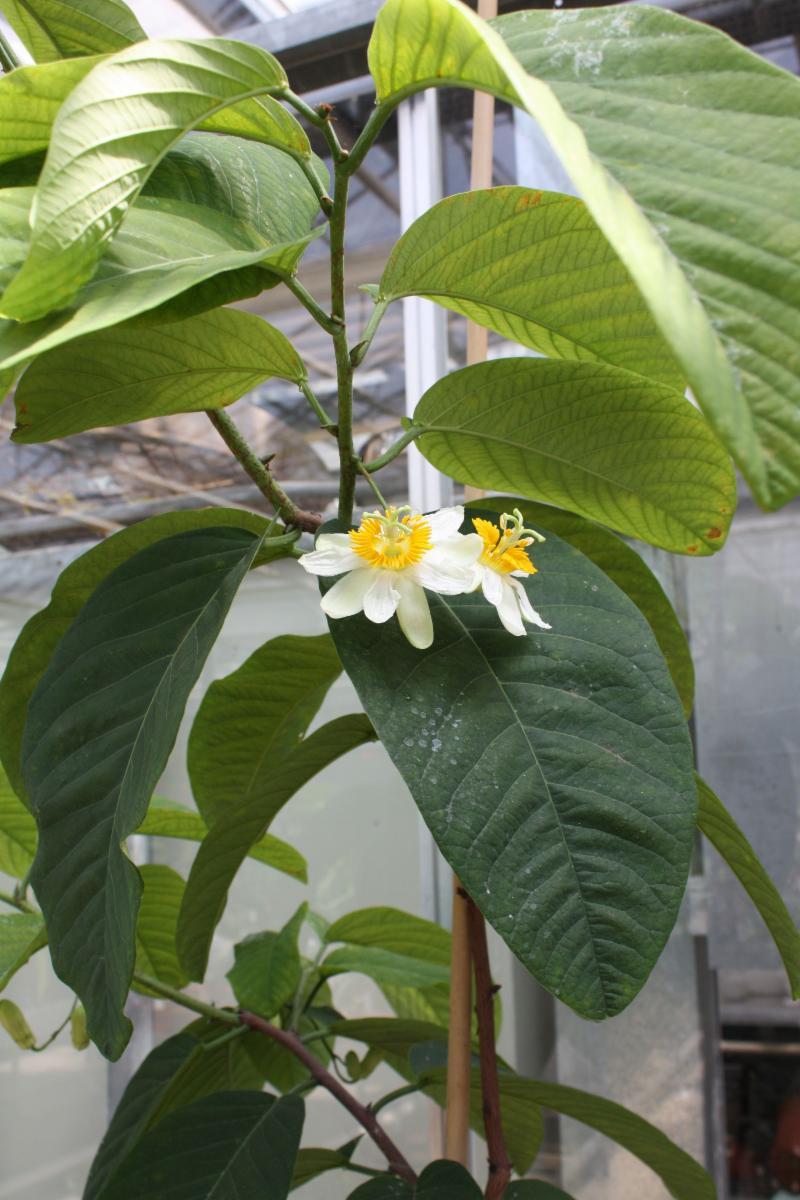
Overview: Small to medium size, free-standing tree, up to 20 m tall (the tallest of all true tree passion flowers) with a basal girth of 1.25 m. Trunks are stout, woody, deep brown and well branched. Unlike most passion flowers this species has no tendrils (climbing aids that are usually found in members of the genus Passiflora ).
Leaves: Most foliage is in the upper portion of the plant. Individual leaves are up to 90 cm long. They are simple and oblong-ovate with two extrafloral nectaries on the midrib below the base of the leaf blade.
Flowers: This is one of the so-called orgy-flowered species, which means that all flower buds will open over the course of just a few days. The 6-7 cm wide flowers are born on single or multi-flowered inflorescences, which are produced exclusively on the plant's new growth. The five sepals are greenish-white, whereas the five petals are pure white. The two series of coronal filaments in the centre of the flower are yellow. The flowers are fragrant, which attracts their pollinator, large bees.
Fruits: Up to 5.5 cm long. Pale yellow when ripe.
Threats and conservation
Passiflora lindeniana has not yet been assessed according to IUCN Red List criteria. Wild specimens are known to face a number of threats that have already resulted in a vast population decline. The main threats are deforestation of their natural habitat for agriculture, felling for firewood by locals and, more recently, attack of maturing fruits by a small fly ( Anastrepha dryas ) that reduces the likelihood of successful regeneration of remaining populations.
Only one Passiflora of subgenus Astrophea ( Passiflora trochlearis ) has so far obtained an IUCN status (Vulnerable D2).
Uses
In Venezuela Passiflora lindeniana is used by locals for firewood.
Within Europe and the United States it is mainly cultivated as a food source for butterflies or for its ornamental value. Because it is relatively difficult to cultivate, it is found mainly in specialised plant collections.
Cultivation
Passiflora lindeniana is regarded as a relatively difficult passion flower to cultivate. The reason for this is that plants in cultivation, as well as in the wild, can go through episodic dormancies, whereby the whole plant suddenly drops all leaves. The cause is unknown, but it is thought to be a response to unfavourable climatic conditions. Given that the plants naturally occur in higher elevations, where temperatures are low, they are most suitable for cultivation in a temperate glasshouse. Under glass, summer temperatures should not exceed 25°C, and during winter the plants should be kept at around 10°C.
Plants are best grown from seed, which is widely available and germinates readily. Plants can also be propagated by vegetative means. At Kew, successful methods of propagation include semi-ripe cuttings, air-layering and grafting onto the rootstock of P. macrophylla
.
Common glasshouse pest and diseases include mealy bug, red spider mite and western flower thrips.
In cultivation the flowers can be expected from late spring to early autumn. When flowering takes place, all blooms open within a couple of days (a phenomenon known as orgy-flowered).
This species at Kew
Passiflora lindeniana can be seen growing in Kew's Princess of Wales Conservatory (in the temperate orchid zone). It is also grown in the behind-the-scenes Tropical Nursery for scientific research.
Pressed and dried and alcohol-preserved specimens of Passiflora lindeniana are held in Kew's Herbarium, where they are available to researchers by appointment. The details of some of these specimens, including an image, can be seen online in Kew's Herbarium Catalogue.