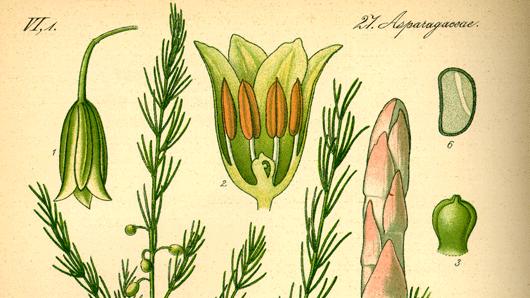
Asparagaceae Juss.

First published in Gen. Pl. Paris. 40. 1789 [4 Aug 1789] (1789)nom. cons.
This family is accepted

Gemma Bramley, Anna Trias-Blasi & Richard Wilford (2023). The Kew Temperate Plant Families Identification Handbook. Kew Publishing Royal Botanic Gardens, Kew

Recognition
Characters of similar families: Amaryllidaceae: usually bulbous, inflorescence pseudoumbellate and enclosed by spathaceous bracts, usually 2. Alstromeriaceae: leaf blades resupinate and usually cauline, inflorescence not scapose with spathaceous bracts. Asphodelaceae: inflorescence usually thyrsoid; there are few morphological characters to distinguish this family from Asparagaceae, so comparison at the subfamily or generic level may be more helpful. Colchicaceae: corms, leaves cauline, inflorescence not scapose with spathaceous bracts. Iridaceae: corms, leaves isobifacial, stamens 3. Liliaceae: naked or tunicate bulbs, leaves cauline. Palmae: leaves compound, plicate and splitting on folds, leaf base tubular. Smilacaceae: climbers with paired tendrils, inflorescence umbellate, flowers unisexual.
Morphology General Habit
Herbs, shrubs, or arborescent with woody growth via anomalous secondary thickening
Vegetative Multiplication
Underground organs rhizomes, tubers, bulbs or a woody caudex
Morphology Stem
Stems usually herbaceous, sometimes woody (Cordyline and Yucca)
Morphology Leaves
Leaves normally arranged in a basal rosette, sometimes cauline (for example, in Maianthemum and Ruscus), or replaced by modified green stems (phylloclades) (Asparagus), or fleshy and spine-tipped in Agave
Morphology Reproductive morphology Inflorescences
Inflorescences usually racemose, also spicate, paniculate or cymose, with 3 or more bracts subtending but not enclosing the inflorescence, or no bracts
Morphology Reproductive morphology Flowers
Flowers often actinomorphic on articulated pedicels, sometimes fragrant, tepals 6, free or fused, stamens usually 6, and inserted at the base of the tepal lobes or on the tube, filaments free, ovary superior or inferior, 3-locular, 1–many seeds per locule, style short with lobed, divided or capitate stigma
Morphology Reproductive morphology Fruits
Fruit a capsule or berry
Morphology Reproductive morphology Seeds
Seeds often black, rounded, subglobular or flattened, sometimes winged.
Distribution
A morphologically heterogeneous family of c.150 genera and 2,595 species. The family is cosmopolitan and includes genera that previously belonged to other traditional families. Some of the more notable temperate genera, including introduced taxa, are Anthericum, Asparagus, Cordyline, Hosta, Hyacinthoides, Ruscus, Scilla and Yucca.
Note
Herbs or shrubs, occasionally arborescent. Leaves arranged in a rosette or clustered on short stems. Inflorescences often racemose, pedicels often articulated. Fruit a capsule or berry. Seeds often black.
Description Author
Martin Xanthos
[KTEMP-FIH]

Timothy M. A. Utteridge and Laura V. S. Jennings (2022). Trees of New Guinea. Kew Publishing. Royal Botanic Gardens, Kew

Note
The Asparagaceae, as delimited in the APG system, is a morphologically heterogenous family and includes many taxa traditionally placed in separate families, and in New Guinea the only woody genera are Cordyline Comm. ex R.Br. and Dracaena Vand. ex L. which were foremerly considered members of the Agavaceae; Wilkin (2014) gives a morphological overview of the new circumscription of the family.
Distribution
The family is pantropical and cosmopolitan, with c. 70–100 genera and 2500 species, especially diverse in the seasonally arid and arid tropics.
Morphology General Habit
Herbs, climbers, shrubs or arborescent with woody growth via anomalous secondary thickening
Vegetative Multiplication
Underground organs rhizomes, bulbs, corms, tuberous roots or a woody caudex
Morphology General Indumentum
Hairs uncommon
Morphology Stem
Stems absent to large and trunk-like
Morphology Leaves
Leaves usually narrow, basal in stemless taxa, usually crowded at stem apices (alternate in climbing taxa or occasionally absent), venation parallel, reticulate secondary venation rare
Morphology Reproductive morphology Inflorescences
Inflorescences often racemose, also spicate, paniculate and cymose, lacking spathaceous bracts at scape/peduncle apex or with 3 or more
Morphology Reproductive morphology Flowers
Flowers often on articulated pedicels, usually actinomorphic, tepals 6, free to fused, stamens usually 6, usually free; ovary superior to inferior, 3-locular; styles divided at apex, not bifid. Fruit often capsular, but berries and other types occur
Morphology Reproductive morphology Seeds
Seeds often black due to phytomelan.
[TONG]

Timothy Utteridge & Gemma Bramley (2020). The Kew Tropical Plant Families Identification Handbook, Second Edition. Kew Publishing Royal Botanic Gardens, Kew

Note
Usually glabrous. Leaves mainly in rosettes or clustered on short stems, bifacial. Inflorescences often racemose, if umbelliform then underground parts cormous or a woody rhizome, never bulbous; pedicels often articulated. Fruit usually a capsule or berry. Seeds often black.
Recognition
Characters of similar families: Amaryllidaceae: usually bulbous, inflorescences scapose, pseudoumbellate, enclosed by fleshy spathaceous bracts in bud (usually 2). Iridaceae: usually with unifacial leaves, stamens 3, ovary inferior, styles branched. Orchidaceae: flowers with a labellum, sexual organs mutually adnate, pollen in pollinia, microseeds. Xanthorrhoeaceae: inflorescence a panicle or if a raceme either a succulent with tubular flowers or a herb with membranous leaf sheaths, seeds always phytomelanous.
Morphology General Habit
Herbs, climbers, shrubs or arborescent with woody growth via anomalous secondary thickening
Vegetative Multiplication
Underground organs rhizomes, bulbs, corms, tuberous roots or a woody caudex
Morphology General Hair
Hairs uncommon
Morphology Stem
Stems absent to large and trunk-like
Morphology Leaves
Leaves usually narrow, basal in stemless taxa, at stem apices or alternate in climbing taxa (Behnia, Herreria and Eustrephus); occasionally absent (with phylloclades, e.g. in Asparagus), venation parallel, reticulate secondary venation rare
Morphology Reproductive morphology Inflorescences
Inflorescences often racemose, also spicate, paniculate and cymose (paniculate taxa either lacking seed phytomelan or rhizomatous with herbaceous, not membranous, leaf sheaths), lacking spathaceous bracts at scape–peduncle apex or with 3 or more; capitate or umbelliform inflorescences never enclosed by 2 fleshy bracts in bud, and with bracts scarious throughout development
Morphology Reproductive morphology Flowers
Flowers often on articulated pedicels, usually actinomorphic, tepals 6, free to fused (except in Tupistra and Aspidistra), stamens 6 (rarely 3, 4, 8, 10 or 12), usually free; ovary superior to inferior, 3-locular; styles divided at apex, not bifid
Morphology Reproductive morphology Fruits
Fruit often capsular, but berries and other types occur
Morphology Reproductive morphology Seeds
Seeds often black due to phytomelan.
Ecology
Especially diverse in the seasonally arid and arid tropics
Distribution
Demissew, S. (2006). Asparagaceae. In: H. J. Beentje & S. A. Ghazanfar (eds), Flora of Tropical East Africa. Royal Botanic Gardens, Kew. Chase, M. W., Reveal, J. L. & Fay, M. F. (2009). A subfamilial classification for the expanded asparagalean families Amaryllidaceae, Asparagaceae and Xanthorrhoeaceae. Bot. J. Linn. Soc. 161: 132–136. Asparagaceae as defined by APG111 is morphologically heterogenous, including many taxa traditionally placed in separate families. Pantropical and cosmopolitan, c. 120 genera and 2,500 species, especially diverse in the seasonally arid and arid tropics. The major tropical taxa are Agave, Asparagus, Chlorophytum, Dracaena (including Sansevieria), Dasylirion, Nolina, Scilla and allies (Hyacinthaceae sensu APG11), and Yucca. Stedje, B. (1997). Hyacinthaceae. In: R. Polhill (ed.), Flora of Tropical East Africa. Royal Botanic Gardens, Kew. Kativu, S., Hoell, G., Bjorå, C. S. & Nordal, I. (2008). Anthericaceae. In: J. Timberlake & E. S. Martins (eds), Flora Zambesiaca 13 (1), Royal Botanic Gardens, Kew. Gentry, H. S. (1982). Agaves of Continental North America. University of Arizona Press, Tucson, Arizona.
Description Author
Paul Wilkin
[KTROP-FIH]

Asparagaceae, Sebsebe Demissew. Flora of Tropical East Africa. 2006

Morphology General Habit
Perennial scandent or erect shrubs or subshrubs, branching; rhizomes sympodial from where the branches are growing; roots often swollen and fusiform
Morphology General Spines
Spines present or absent; when present these are formed usually from the reduced leaves, occasionally from branches
Morphology Leaves
Leaves normally reduced and scale-like, the assimilating function taken by modified green branches (cladodes); in some genera the branches are transformed into flattened, leaf-like cladodes (phylloclades)
Morphology Stem Cladodes
Cladodes solitary or fascicled, subulate, angled or linear
Morphology Reproductive morphology Inflorescences
Inflorescence axillary or terminal, solitary, fascicled or assembled in racemes or “ umbels”
Morphology Reproductive morphology Flowers
Flowers unisexual or bisexual, actinomorphic, small, erect or pendulous
Morphology Reproductive morphology Flowers Perianth
Perianth with 6 tepals in two series, all similar in shape, free or fused at the base, white, cream, yellow or green
Morphology Reproductive morphology Flowers Androecium
Stamens 6, in two series, fused to the perianth segments, present both in unisexual and bisexual flowers, non-functional in female unisexual flowers; filaments free from each other, anthers introrse, dorsifixed; pollen grains sulcate
Morphology Reproductive morphology Flowers Gynoecium
Pistil with 3 carpels united to form a 2– 3-locular ovary with 1– 12 ovules in each locule; placentation axile; style short with capitate or lobed stigma
Morphology Reproductive morphology Fruits
Fruit a globose berry with 1– 2(– 3) seeds
Morphology Reproductive morphology Seeds
Seeds black, globose or truncate on one side, convex on the other
Distribution
Family represented by the genus Asparagus with two subgenera, subgenus >i>Asparagus and subgenus >i>Myrsiphyllum (S.T. Malcomber & Sebsebe Demissew in Kew Bull. 48(1): 63– 78 (1993)). The members are widely distributed in the old world. Most species are found in arid tropical regions and Mediterranean climates
[FTEA]

George R. Proctor (2012). Flora of the Cayman Isands (Second Edition). Royal Botanic Gardens, Kew

Morphology General Habit
Trees or shrubs with woody stems or else short-stemmed or stemless succulent herbs with fleshy creeping rhizomes; woody stems usually with secondary thickening
Morphology Leaves
Leaves entire, lanceolate or linear-lanceolate to ovate and flat, channeled, cylindric or laterally compressed, sessile, glabrous, fleshy or leathery, rigid or flexible, often clustered at growing tips or in rosettes at the ends of branches
Morphology Reproductive morphology Inflorescences
Inflorescence an axillary raceme or panicle; flowers bisexual, hypogynous, often fragrant; pedicels articulate; perianth tubular or funnel-shaped, the lobes 6, narrow, subequal, spreading or reflexed when fully expanded
Morphology Reproductive morphology Flowers Androecium Stamens
Stamens 6, inserted at base of the lobes, the anthers dorsifixed, versatile, introrse
Morphology Reproductive morphology Flowers Gynoecium Ovary
Ovary superior, 3-locular, with a single or many ovules in each locule; style slender, terminated by a 3-lobed or capitate stigma
Morphology Reproductive morphology Fruits
Fruit a fleshy berry or sometimes hard and woody, usually red or orange; seeds 1–3, bony, globose or elongate.
[Cayman]

Dracenaceae, Geoffrey Mwachala & Paul Mbugua, Flora of Tropical East Africa. 2007

Morphology General Habit
Trees, shrubs or herbs
Morphology Leaves
Leaves alternate, rosulate, distichous or spirally arranged, sometimes in pseudo-whorls, sessile, the base often (semi-)amplexicaul, succulent or not; primary venation parallel
Morphology Reproductive morphology Inflorescences
Inflorescence usually a terminal panicle, occasionally appearing racemose by reduction of primary branches; pedicel of a peg-like basal part crowned by a distinct joint, and an obconical receptacle, persistent in fruit
Morphology Reproductive morphology Flowers
Flowers in irregular clusters, 1–several per cluster, subsessile, with a bract subtending each flower, fragrant, nocturnal; perianth tubular, with 6 spreading or recurving lobes
Morphology Reproductive morphology Flowers Androecium Stamens
Stamens 6, inserted in the throat, with inflated or filiform filaments; anthers dorsifixed, versatile, opening by lateral slits
Morphology Reproductive morphology Flowers Gynoecium Pistil
Ovary superior, free, globose, 3-celled; ovules erect, solitary in each of the three chambers; style filiform; stigma capitate
Morphology Reproductive morphology Fruits
Fruit a berry, 1–3-seeded
Morphology Reproductive morphology Seeds
Seeds rounded, bony, white.
[FTEA]

Eriosphermaceae, Christopher Whitehouse, B.A.. Flora of Tropical East Africa. 1996

Morphology General Habit
Herbs with perennial tubers and annual aerial parts, glabrous or partly pubescent (not in East Africa)
Vegetative Multiplication Tubers
Tubers globose to irregularly shaped; flesh white, yellow, pink or purplish red; growing points one or more, protected by a neck of sheathing fibrous remains of leaf-bases
Morphology Leaves
Leaves 1-5, appearing with or after the flowers, erect to prostrate; blade linear to broadly ovate (sometimes circular or with enations in southern Africa), often with a distinct petiole-like base
Morphology Reproductive morphology Inflorescences
Inflorescence a simple raceme, few-many-flowered, cylindrical to corymbose, dense to lax, upper flowers sometimes sterile or aborted; peduncle erect to suberect, sometimes subtended by a leaf-like sheath; bracts minute, solitary, at the base of a single pedicel; pedicels short to long, erect to spreading, articulated at the apex
Morphology Reproductive morphology Flowers
Flowers small, regular, rotate, campanulate or triangular, opening in the sun; tepals in 2 whorls of 3, connate at the base, subequal to equal or dimorphic, white, pink, yellow or green and often with a darker coloured midnerve, persistent
Morphology Reproductive morphology Flowers Androecium
Stamens 6, hypogynous, joined to the base of the tepals; filaments filiform to broadly lanceolate, white, yellow, orange or purple blotched; anthers, dorsifixed, versatile, subglobose to oval, introrse
Morphology Reproductive morphology Flowers Gynoecium
Ovary superior, sessile, with 3 locules, each with 2-6 axile ovules; style terete; stigma apical, small
Morphology Reproductive morphology Fruits
Fruit a loculicidal capsule, turbinate to ovoid
Morphology Reproductive morphology Seeds
Seeds oval to comma-shaped, densely covered with hairs, silvery white when fresh, turning brown with age
[FTEA]

Agavaceae, F.N. Hepper. Flora of West Tropical Africa 3:1. 1968

Morphology General Habit
Rootstock a rhizome; stem short or well developed
Morphology Leaves
Leaves usually crowded on or at the base of the stem often thick and fleshy, entire or with prickly teeth on the margin
Morphology Reproductive morphology Flowers
Flowers bisexual, polygamous or dioecious, racemose to paniculate or subcapitate, sometimes in a very large thyrse, bracteate
Morphology Reproductive morphology Flowers Perianth
Perianth segments free or united; corona never present
Morphology Reproductive morphology Flowers Androecium
Stamens 6, inserted at the base of the lobes or on the tube; filaments filiform or thickened, free; anthers introrse, 2-locular, opening lengthwise
Morphology Reproductive morphology Flowers Gynoecium
Ovary superior or inferior, often beaked, 3-locular, with axile placentas; style slender Ovules numerous and superposed in two series to solitary
Morphology Reproductive morphology Fruits
Fruit a capsule or berry
Morphology Reproductive morphology Seeds
Seeds with fleshy endosperm
[FWTA]

George R. Proctor (2012). Flora of the Cayman Isands (Second Edition). Royal Botanic Gardens, Kew

Morphology General Habit
Chiefly large, more or less succulent, leathery or fibrous rosette to very large rosette shrubs or trees with stout woody trunks often with secondary tissue growth
Morphology Roots
Roots fibrous and sometimes rhizomatous; plants sometimes proliferating by means of stolons
Morphology Leaves
Leaves spirally arranged and with margins entire, spiny or toothed, usually broadest near the base and gradually tapering to a sharp apex; the vascular bundles in the leaves are accompanied by thick, strong fibers, thus various species are used as textile plants
Morphology Reproductive morphology Inflorescences
Inflorescence stalks (scapes) stout, terminal, clothed with few or many more or less appressed bracts; inflorescences large, paniculate with more or less cymose branches; many species are monocarpic, producing a giant inflorescence and then dying
Morphology Reproductive morphology Flowers
Flowers usually bisexual, trimerous, hypogynous or epigenous, actinomorphic or slightly zygomorphic, and usually arising from the axils of well-developed bracts; tepals (segments) most often white or yellow, free or more or less fused into a tubular or campanulate perianth, sometimes abruptly widened and urceolate in the outer part
Morphology Reproductive morphology Flowers Androecium Stamens
Stamens 6, inserted at or near the base of the perianth, the filaments sometimes short and relatively stout (Yucca) or else filiform and long-exserted (Agave); anthers introrse, often peltate, opening longitudinally; pollen with reticulate exine, the grains dispersed singly or in tetrads
Morphology Reproductive morphology Flowers Gynoecium Ovary
Ovary 3-locular, each cavity with several to many ovules; style short to rather long, with punctiform to trilobate stigma
Morphology Reproductive morphology Fruits
Fruit a dry or berry-like capsule containing several to many seeds; seeds often flattened or compressed.
Distribution
An entirely New World family of about 8 genera and more than 300 species.
[Cayman]

Stedje, B. & Kativu, S. (2023). Hyacinthaceae. In: M.A. García & B.F.P. Loeuille (eds), Flora Zambesiaca, Vol. 13(3). Royal Botanic Gardens, Kew.

Morphology General Habit
Bulbous perennial geophytes
Vegetative Multiplication Bulbs
Bulbs formed from thickened cataphylls and old leaf bases
Morphology Leaves
Leaves 1 to many, rarely lacking in adult plants (Bowiea, Schizobasis), in rosettes, sometimes pseudopetiolate (some Ledebouria, Drimiopsis)
Morphology Roots
Roots often branched, moderately thick to fusiform (Eucomis); contractile roots often present
Morphology Reproductive morphology Inflorescences
Inflorescence scapose, comprising a simple raceme or occasionally a spike, rarely strongly branched (Bowiea, Schizobasis), bearing 1 to hundreds of flowers; pedicels non-articulated
Morphology Reproductive morphology Flowers
Flowers hermaphrodite, hypogynous, actinomorphic. Tepals 3 + 3, free or ± united, white, blue, purple, yellow, brownish or greenish, inner and outer almost equal in size and colour
Morphology Reproductive morphology Flowers Androecium Stamens
Stamens 3 + 3, variously shaped, sometimes bearing appendages, the filaments sometimes united at base or with tepals
Morphology Reproductive morphology Flowers Androecium Stamens Anthers
Anthers introse, dehiscing longitudinally
Morphology Reproductive morphology Flowers Gynoecium Pistil
Pistil syncarpous, trilocular; style with a simple stigma; ovary superior, rarely (Bowiea) partly inferior, sessile, rarely stipitate (Ledebouria and some Dipcadi); ovules usually many or sometimes 1–2 in each locule (Ledebouria and Drimiopsis)
Morphology Reproductive morphology Fruits
Capsule loculicidally dehiscing, dry or fleshy
Morphology Reproductive morphology Seeds
Seeds spherical, ellipsoidic, rounded or flattened and angular, black or brownish.
Distribution
A family of c.67 genera and 900 species, with the greatest diversity in South Africa and the Mediterranean region. Its range extends across NW Europe, Central and East Asia, North America and the Andes in South America. 15 genera in the Flora area.
Note
The generic delimitation of Hyacinthaceae has been controversial over recent years and several papers with contradicting generic concepts have been published, causing confusion. Under APG IV (Angiosperm Phylogeny Website, ver.14, July 2017), Hyacinthaceae is included in the family Asparagaceae and regarded as a subfamily, Scilloideae Burnett. The Plants of the World Online (https://powo.science.kew.org), and similar resources, treats all Hyacinthaceae taxa described here under Asparagaceae. In this flora we are following the older delimitaion in order to fit in with already-published parts of Flora Zambesiaca and to be compatible with the Flora of Tropical East Africa (F.T.E.A.). The genera Lithanthus and Schizobasis (including Urginea) were included in Drimia by Manning et al. (2004), but the evidence for doing so was weak. Their status as separate genera have not been questioned by other authors and we prefer to keep them as separate based on their morphological distinctness. The genera Bowiea and Eucomis were accepted by Manning et al. (2004) and have not been questioned by other authors. Scilla is another genus that has traditionally accommodated several species from Europe, Asia and Africa. Jessop (J. S. Afr. Bot. 36: 233–266, 1970) reappraised the genus Ledebouria to cater for many of African species previously placed in Scilla, whilst others remained in Scilla. It has been shown (Pfosser & Speta in Ann. Missouri Bot. Gard. 86: 852‒875, 1999) that species N and S of the Sahara belong to different linages, thus Manning et al. (2004) transferred the Flora Zambesiaca species to Merwilla and Schizocarphus. They included the genus Drimiopsis in Ledebouria, but subsequently these genera were upheld as separate by Lebata et al. (2006). Manning et al. (2004) merged the up-to-then widely accepted genera Albuca, Dipcadi, Ornithogalum and Pseudogaltonia into one large genus, Ornithogalum. Later, Albuca, Dipcadi and Pseudogaltonia were reappraised, but with a wide concept of the genus Albuca including species traditionally referred to Ornithogalum, in order to make the genus monophyletic (Manning et al. 2009). Ornithogalum has traditionally been a large and somewhat heterogeneous genus comprising species from Europe, Asia and Africa. Martínez- Azorín et al. (2011) split it into several genera, three of which contain species in the Flora area, Battandiera, Nicipe and Stellarioides, using Ornithogalum is for Mediterranean and Asian species only. We have here chosen to follow Manning et al. (2009).
[FZ]

Hyacinthaceae, Brita Stedje, Ph.D.. Flora of Tropical East Africa. 1996

Morphology General Habit
Herbs with bulbs
Morphology Leaves
Leaves in a basal rosette from the apex of the bulb or lacking, filiform, lanceolate or cordate, with or without spots, sometimes with papillae or hairs
Morphology Reproductive morphology Inflorescences Scape
Scape leafless
Morphology Reproductive morphology Inflorescences
Inflorescence most often a raceme or a spike, rarely much branched and complex, if much branched then leaves lacking or strongly reduced
Morphology Reproductive morphology Flowers
Flowers greenish to white or yellowish, purplish to purple or blue, often with a green or dark midrib
Morphology Reproductive morphology Flowers Perianth
Perianth-segments 6, free or fused into a shorter or longer tube
Morphology Reproductive morphology Flowers Gynoecium
Ovaries with 1-many ovules per locule
Morphology Reproductive morphology Fruits
Fruit a loculicidal capsule, rarely schizocarpous
Morphology Reproductive morphology Seeds
Seeds black and subglobular or flattened, sometimes winged
[FTEA]

Uses

Use
Many species have been introduced into all warmer parts of the world, either for ornament or for commercial production of textiles, and some of these have become naturalized in various countries.
[Cayman]

Common Names

unknown
sisal

Sources

  • EBC Common Names

    • Common Names from Kew's Economic Botany Collection https://www.kew.org/science/collections-and-resources/collections/economic-botany-collection
  • Flora Zambesiaca

    • Flora Zambesiaca
    • http://creativecommons.org/licenses/by-nc-sa/3.0
  • Flora of Tropical East Africa

    • Flora of Tropical East Africa
    • http://creativecommons.org/licenses/by-nc-sa/3.0
  • Flora of West Tropical Africa

    • Flora of West Tropical Africa
    • http://creativecommons.org/licenses/by-nc-sa/3.0
  • Flora of the Cayman Islands

    • Flora of the Cayman Islands
    • http://creativecommons.org/licenses/by-nc-sa/3.0
  • Kew Names and Taxonomic Backbone

    • The International Plant Names Index and World Checklist of Vascular Plants 2026. Published on the Internet at http://www.ipni.org and https://powo.science.kew.org/
    • © Copyright 2023 International Plant Names Index and World Checklist of Vascular Plants. http://creativecommons.org/licenses/by/3.0
  • Trees of New Guinea

    • Trees of New Guinea
    • http://creativecommons.org/licenses/by-nc-sa/3.0
  • The Kew Temperate Plant Families Identification Handbook

    • The Kew Temperate Plant Families Identification Handbook
    • http://creativecommons.org/licenses/by-nc-sa/3.0
  • The Kew Tropical Plant Families Identification Handbook

    • The Kew Tropical Plant Families Identification Handbook
    • http://creativecommons.org/licenses/by-nc-sa/3.0