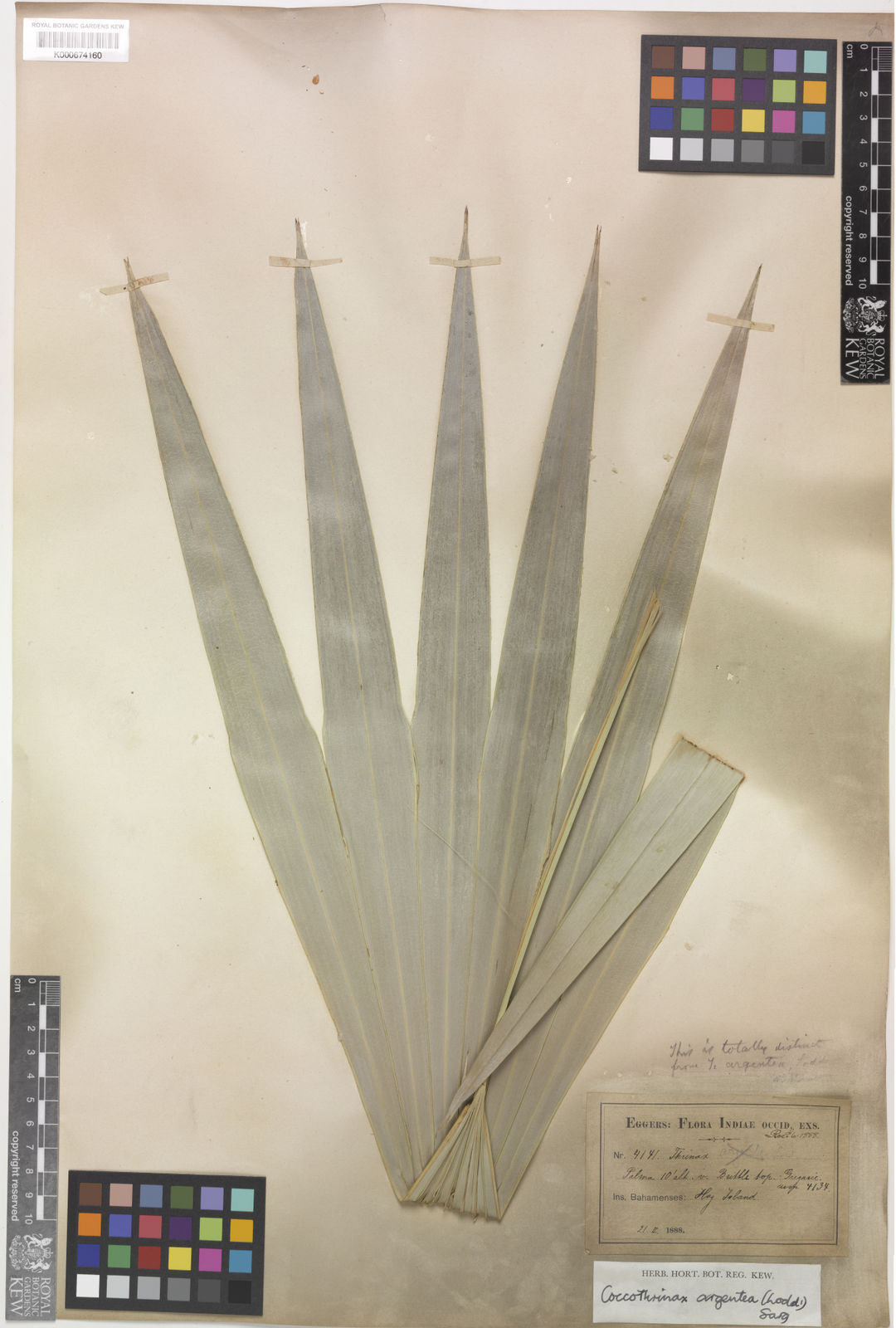
Thrinax L.f. ex Sw.

First published in Prodr. Veg. Ind. Occid.: 57 (1788)
This genus is accepted
The native range of this genus is S. Florida, SE. Mexico to Honduras, Caribbean.

Descriptions

George R. Proctor (2012). Flora of the Cayman Isands (Second Edition). Royal Botanic Gardens, Kew

Morphology General Habit
Mostly rather slender, unarmed trees. Leaves long-petiolate, the chiefly orbicular blades palmately cleft with narrow lobes, these 2-parted at the apex and obliquely folded; hastula thick, concave, pointed, often tomentose within when young
Morphology Reproductive morphology Inflorescences Spadix
Spadix interfoliar, paniculate, partly enclosed toward the base by numerous tubular tomentose spathes
Morphology Reproductive morphology Flowers
Flowers perfect, subequally 6-parted; stamens mostly 6, the filaments connate at the base; ovary superior, the stigma flat or concave; ovule solitary with lateral micropyle
Morphology Reproductive morphology Fruits
Fruit 1- seeded, globose, usually white at maturity; seed with smooth endosperm.
Distribution
A chiefly West Indian genus of 8 or 10 species or fewer.
[Cayman]

Sources

  • Flora of the Cayman Islands

    • Flora of the Cayman Islands
    • http://creativecommons.org/licenses/by-nc-sa/3.0
  • Kew Backbone Distributions

    • The International Plant Names Index and World Checklist of Vascular Plants 2026. Published on the Internet at http://www.ipni.org and https://powo.science.kew.org/
    • © Copyright 2023 World Checklist of Vascular Plants. http://creativecommons.org/licenses/by/3.0
  • Kew Names and Taxonomic Backbone

    • The International Plant Names Index and World Checklist of Vascular Plants 2026. Published on the Internet at http://www.ipni.org and https://powo.science.kew.org/
    • © Copyright 2023 International Plant Names Index and World Checklist of Vascular Plants. http://creativecommons.org/licenses/by/3.0