Spathodea campanulata P.Beauv.

First published in Fl. Oware 1: 47 (1805)
This species is accepted
The native range of this species is W. Tropical Africa to Uganda and Angola. It is a tree and grows primarily in the wet tropical biome. It is used as animal food, a poison and a medicine, has environmental uses and social uses and for fuel and food.

Descriptions

Shahina A. Ghazanfar (2015). Flora of Oman, Volume 3: Loganiaceae - Asteraceae. National Botanic Garden of Belgium

Note
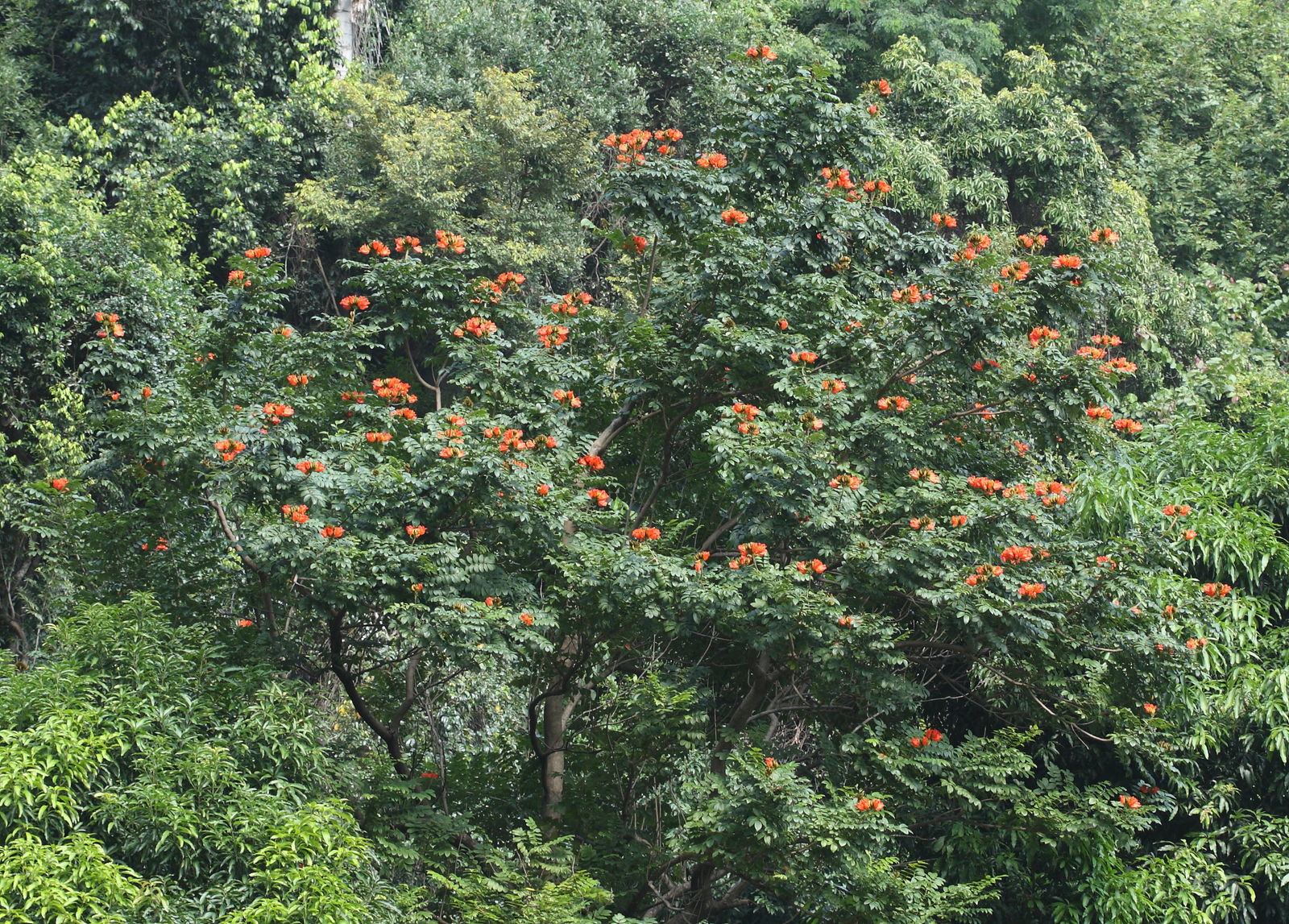
Spathodea campanulata (African Tulip tree) is a tree to 10 m with showy reddish-orange flowers and bright green ovate leaves. It is not commonly cultivated in Oman and I have not seen it public parks.
[FO]

Bignoniaceae, Sally Bidgood, Bernard Verdcourt, Kaj Vollesen. Cobaeaceae, Bernard Verdcourt. Flora of Tropical East Africa. 2006

Figures
Fig. 7, p. 30.
Type
Type: Nigeria, about 12 km N of Chama, Palisot de Beauvois (G, holo)
Morphology General Habit
Tree to 30 m tall, bark grey-brown, variously described as smooth, finely longitudinally fissured or rough.
Morphology Branches
Young branches smooth or slightly striate, lenticellate, glabrous to pubescent or tomentose.
Morphology Leaves Leaflets
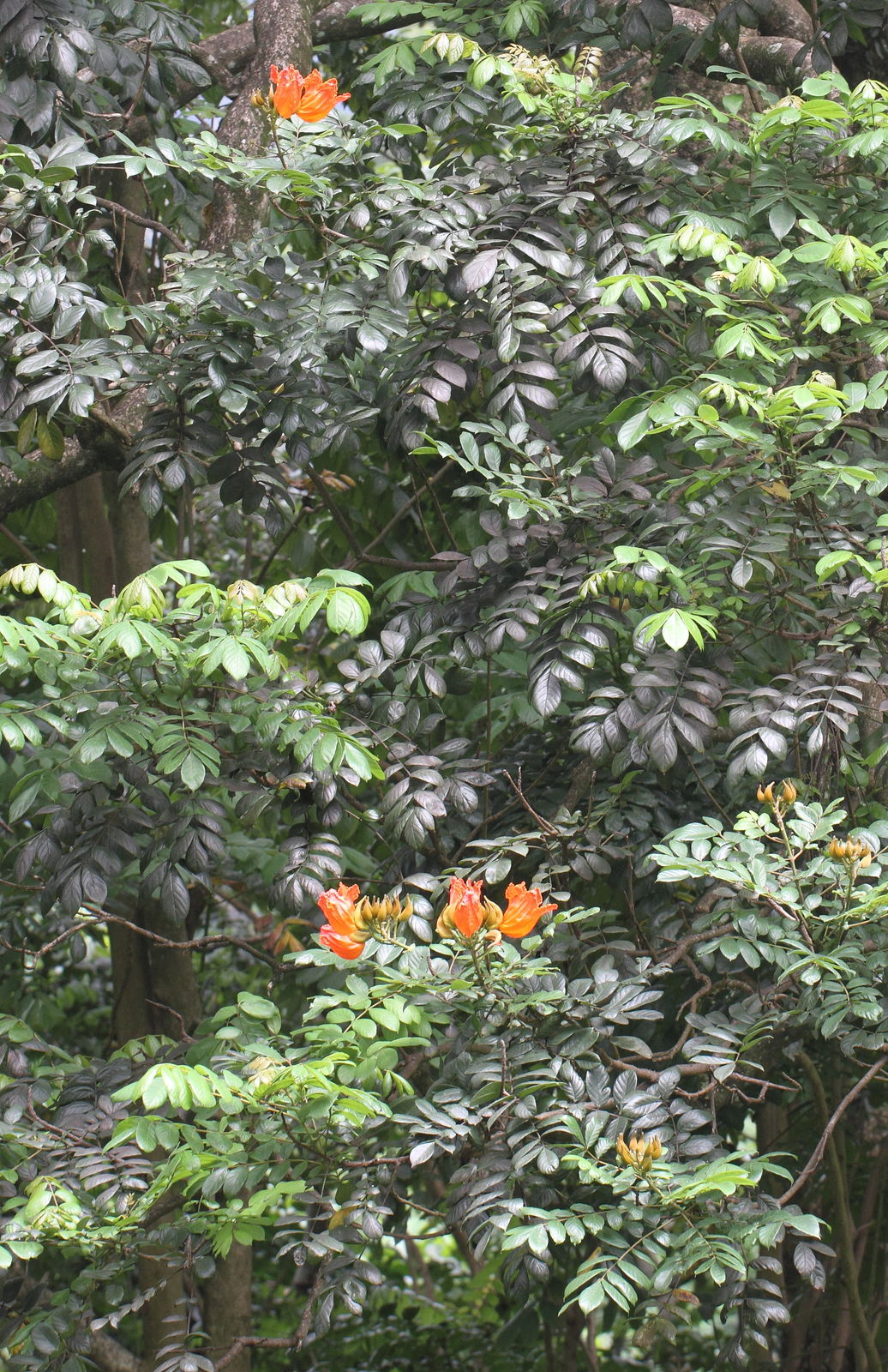
Leaflets 4–8 pairs, narrowly elliptic to elliptic, (6–)8–15 × 2–7 cm, petiolules if present up to 0.4(–0.7) cm long, base rounded to acute and frequently unequal, margins entire or repand, apex acute to acuminate or cuspidate, upper surface glabrous or with a few scattered hairs mainly on the veins, lower surface glabrous or densely tomentose to tomentose, rarely with only a few scattered hairs, mainly on the veins and showing the dense reticulation, both surfaces with scattered peltate glands, usually with several large glands at the leaf base; terminal leaflet elliptic to broadly elliptic to obovate, base rounded to cuneate and often unequal, apex acute or acuminate (rarely lobed).
Morphology Leaves Petiole
Petiole 8–28(–30) cm long, sometimes with leafy pseudostipules at base, 1–1.5 × 1–1.5 cm.
Morphology Reproductive morphology Inflorescences
Inflorescence 13–45-flowered.
Morphology Reproductive morphology Inflorescences Peduncles
Peduncle lenticellate, with prominent scars left by fallen pedicels, glabrous to densely tomentose.
Morphology Reproductive morphology Inflorescences Bracts
Bracts lanceolate, 1–2 × 0.2–4 cm. Bracts and bracteoles with scattered peltate glands ± 1 mm wide.
Morphology Reproductive morphology Inflorescences Bracteoles
Bracteoles two, at the base of each flower, sometimes elsewhere on the pedicel.
Morphology Reproductive morphology Flowers Calyx
Calyx (3–)3.5–6(–6.3) × (1.2–)2–3.6(–4) cm, tapering, acuminate and recurved at the apex, glabrous or with a few scattered curly hairs, or densely covered with very short velvety hairs or densely tomentose with multicellular hairs.
Morphology Reproductive morphology Flowers Corolla
Corolla red to orange tinged with yellow, rarely wholly yellow, glabrous on the outside, sparsely pubescent on the inside, with short crisped glandular and non-glandular multicellular hairs, more towards the base, 7.5–13.5 × (6.2–)7–12 cm; lobes broadly triangular to rounded, 1–3.5 × 2–3.5 cm, margin crinkly; tube 1.2–1.5 × 0.5–0.6 cm, enclosed within calyx.
Morphology Reproductive morphology Flowers Androecium Stamens
Stamens: anthers adnate to the corolla at the mouth of the tube, with the anticous equalling the length of the corolla, the posticous normally shorter.
Morphology Reproductive morphology Sporangia
Thecae divergent, 6–9 × ± 1 mm, glabrous.
Morphology Reproductive morphology Flowers Disc
Disk thick, lobed, annular. Ovary ± 5 mm long, either glabrous or villous with multicellular hairs.
Morphology Reproductive morphology Flowers Gynoecium Style
Style 5–7 cm long.
Morphology Reproductive morphology Flowers Gynoecium Stigma
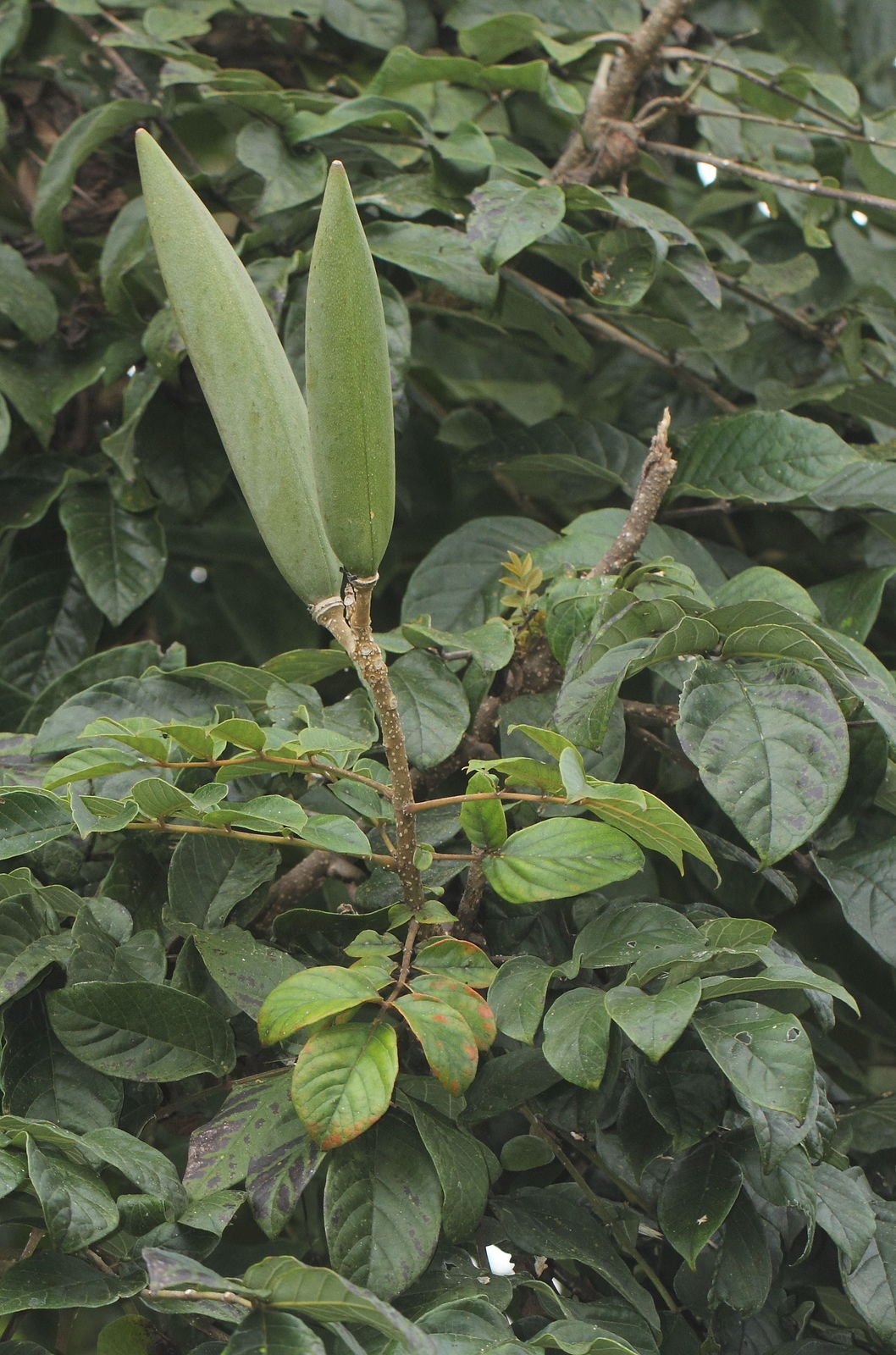
Stigma 2-lobed, flattened, with lobes 5–7 × 2–3 mm, ± elliptic. Fruit held erect, slightly woody, fusiform, 15–23 × 2.5–4.3 cm, compressed, angular (like a flat–bottomed boat when dehisced), lenticellate, glabrous or densely tomentose when young, glabrescent when older.
Morphology Reproductive morphology Seeds
Seeds compressed, 0.8–1 × 0.7–1.2 cm; wings hyaline, 1.5–2 × 2–4 cm.
[FTEA]

Bernal, R., Gradstein, S.R. & Celis, M. (eds.). 2015. Catálogo de plantas y líquenes de Colombia. Instituto de Ciencias Naturales, Universidad Nacional de Colombia, Bogotá. http://catalogoplantasdecolombia.unal.edu.co

Distribution
Cultivada en Colombia; Alt. 200 - 1800 m.; Amazonia, Andes, Valle del Cauca.
Morphology General Habit
Árbol
[CPLC]

Bernal, R., G. Galeano, A. Rodríguez, H. Sarmiento y M. Gutiérrez. 2017. Nombres Comunes de las Plantas de Colombia. http://www.biovirtual.unal.edu.co/nombrescomunes/

Vernacular
barquitos, miona, pipí, roble africano, rosa china, tulipán, tulipán africano, tulipán de Gabón, tulipán rojo
[UNAL]

Extinction risk predictions for the world's flowering plants to support their conservation (2024). Bachman, S.P., Brown, M.J.M., Leão, T.C.C., Lughadha, E.N., Walker, B.E. https://nph.onlinelibrary.wiley.com/doi/full/10.1111/nph.19592

Conservation
Predicted extinction risk: not threatened. Confidence: confident
[AERP]

IUCN Red List of Threatened Species https://www.iucnredlist.org/species/49196213/49196223

Conservation
LC - least concern
[IUCN]

M. Thulin et al. Flora of Somalia, Vol. 1-4 [updated 2008] https://plants.jstor.org/collection/FLOS

Morphology Leaves
Leaves 9–15-foliolate; leaflets ± elliptic, 3–16 x 1.5–9 cm, acute to acuminate at the apex
Morphology Reproductive morphology Flowers Calyx
Calyx 4–5.5 cm long
Morphology Reproductive morphology Flowers Corolla
Corolla orange red with a yellow border, 8–15 cm long, 4.5–7 cm wide at mouth of tube
Morphology Reproductive morphology Fruits
Capsule 17–27 x 3.5–7 cm
Morphology Reproductive morphology Seeds
Seeds c. 1.5 x 2 cm including wing.
Distribution
Cultivated at least in S2. Widely cultivated in the tropics and subtropics.
Vernacular
African tulip tree (English).
Note
First record for Somalia. The Somali plant has hairy leaves and calyces and is subsp. nilotica (Seem.) Bidgood.
[FSOM]

Distribution
Biogeografic region: Amazonia, Andean. Elevation range: 200–1800 m a.s.l. Cultivated in Colombia. Colombian departments: Amazonas, Antioquia, Caldas, Quindío, Risaralda, Valle del Cauca.
Habit
Tree.
Conservation
IUCN Red List Assessment (2021): LC.
Ecology
Habitat according IUCN Habitats Classification: forest and woodland, savanna, shrubland, artificial - terrestrial.
[UPFC]

Bignoniaceae, H. Heine. Flora of West Tropical Africa 2. 1963

Morphology General Habit
A tree 20-70 ft. high
Morphology Reproductive morphology Inflorescences
Conspicuous flaming inflorescences, flowers scarlet or orange-red yellow margin
Ecology
Habitat mainly fringing forests.
[FWTA]

Uses

Use
Widely grown as an ornamental
[FSOM]

Use Animal Food
Used as animal food.
Use Environmental
Environmental uses.
Use Fuel
Used for fuels.
Use Gene Sources
Used as gene sources.
Use Food
Used for food.
Use Materials
Used as material.
Use Medicines
Medical uses.
Use Poisons
Poisons.
Use Social
Social uses.
[UPFC]

Common Names

english
African tulip tree
unknown
anchit-anchit

Sources

  • Angiosperm Extinction Risk Predictions v1

    • Angiosperm Threat Predictions
    • http://creativecommons.org/licenses/by/4.0
  • Catálogo de Plantas y Líquenes de Colombia

    • http://creativecommons.org/licenses/by-nc-sa/3.0
  • EBC Common Names

    • Common Names from Kew's Economic Botany Collection https://www.kew.org/science/collections-and-resources/collections/economic-botany-collection
  • Flora of Oman

    • Shahina A Ghazanfar (2003-2018). Flora of the Sultanate of Oman. Meise, Botanic Garden Meise.
    • http://creativecommons.org/licenses/by-nc-sa/3.0
  • Flora of Somalia

    • Flora of Somalia
    • http://creativecommons.org/licenses/by-nc-sa/3.0
  • Flora of Tropical East Africa

    • Flora of Tropical East Africa
    • http://creativecommons.org/licenses/by-nc-sa/3.0
  • Flora of West Tropical Africa

    • Flora of West Tropical Africa
    • http://creativecommons.org/licenses/by-nc-sa/3.0
  • Herbarium Catalogue Specimens

    • Digital Image © Board of Trustees, RBG Kew http://creativecommons.org/licenses/by/3.0/
  • IUCN Categories

    • IUCN Red List of Threatened Species
    • http://creativecommons.org/licenses/by-nc-sa/3.0
  • Kew Backbone Distributions

    • The International Plant Names Index and World Checklist of Vascular Plants 2026. Published on the Internet at http://www.ipni.org and https://powo.science.kew.org/
    • © Copyright 2023 World Checklist of Vascular Plants. http://creativecommons.org/licenses/by/3.0
  • Kew Living Collection Database

    • Common Names from Kew's Living Collection Database
  • Kew Names and Taxonomic Backbone

    • The International Plant Names Index and World Checklist of Vascular Plants 2026. Published on the Internet at http://www.ipni.org and https://powo.science.kew.org/
    • © Copyright 2023 International Plant Names Index and World Checklist of Vascular Plants. http://creativecommons.org/licenses/by/3.0
  • Kew Science Photographs

    • Copyright applied to individual images
  • Universidad Nacional de Colombia

    • ColPlantA database
    • http://creativecommons.org/licenses/by-nc-sa/3.0
  • Useful Plants and Fungi of Colombia

    • http://creativecommons.org/licenses/by-nc-sa/3.0